











Indian chiefs, part 5 - Chief Joseph
von Thomas Blickling
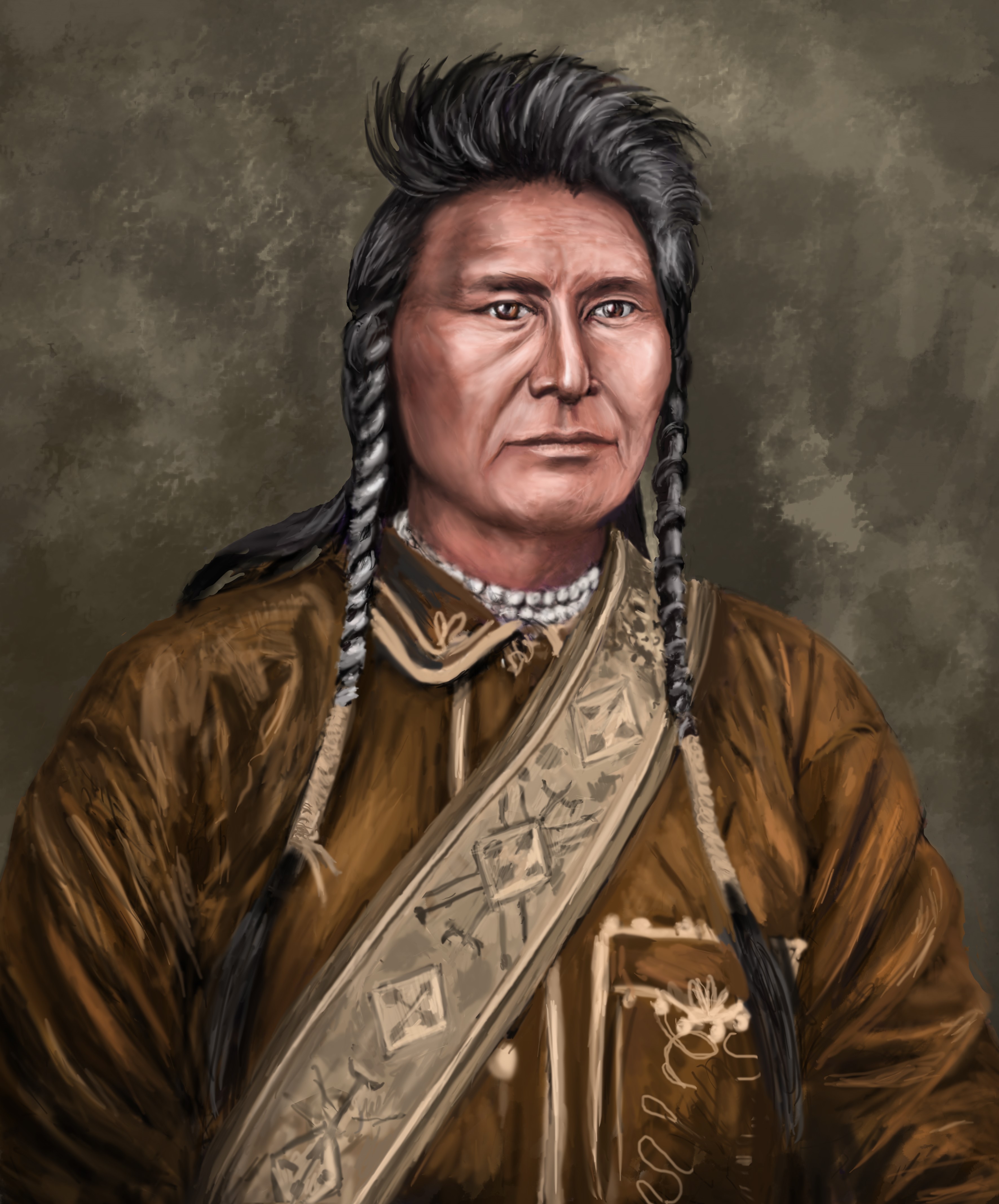
Chief Joseph (March 3, 1840 – September 21, 1904), succeeded his father Tuekakas (Chief Joseph the Elder) as the leader of the Wal-lam-wat-kain (Wallowa) band of Nez Perce, a Native American tribe indigenous to the Wallowa Valley in northeastern Oregon, in the interior Pacific Northwest region of theUnited States.
He led his band during the most tumultuous period in their contemporary history when they were forcibly removed from their ancestral lands in the Wallowa Valley by the United States federal government and forced to move northeast, onto the significantly reduced reservation in Lapwai, Idaho Territory. A series of events which culminated in episodes of violence led those Nez Perce who resisted removal including Joseph's band and an allied band of the Palouse tribe to take flight to attempt to reach political asylum, ultimately with the Lakota chief Sitting Bull in Canada.
They were pursued by the U.S. Army in a campaign led by General Oliver O. Howard. This 1,170-mile (1,900 km) fighting retreat by the Nez Perce in 1877 became known as the Nez Perce War. The skill with which the Nez Perce fought and the manner in which they conducted themselves in the face of incredible adversity led to widespread admiration among their military adversaries and the American public.
Coverage of the war in United States newspapers led to widespread recognition of Joseph and the Nez Perce. For his principled resistance to the removal, he became renowned as a humanitarian and peacemaker. However, modern scholars like Robert McCoy and Thomas Guthrie argue that this coverage, as well as Joseph's speeches and writings, distorted the true nature of Joseph's thoughts and gave rise to a "mythical" Chief Joseph as a "red Napoleon" that served the interests of the Anglo-American narrative of manifest destiny.
Nez Perce War
The Nez Perce War was the name given to the U.S. Army's pursuit of about 750 Nez Perce and a small allied band of the Palouse tribe who had fled toward freedom. Initially they had hoped to take refuge with the Crow nation in the Montana Territory, but when the Crow refused to grant them aid, the Nez Perce went north in an attempt to reach asylum with Sioux Chief Sitting Bull and his followers who had fled to Canada in 1876.
For over three months, the Nez Perce outmaneuvered and battled their pursuers traveling 1,170 miles (1,880 km) across Oregon, Washington, Idaho, Wyoming, and Montana.
General Howard, leading the opposing cavalry, was impressed with the skill with which the Nez Perce fought, using advance and rear guards, skirmish lines, and field fortifications. Finally, after a devastating five-day battle during freezing weather conditions with no food or blankets, with the major war leaders dead, Joseph formally surrendered to General Nelson Appleton Miles on October 5, 1877 in the Bear Paw Mountains of the Montana Territory, less than 40 miles (60 km) south of Canada in a place close to the present-day Chinook in Blaine County.
Famous quote of Chief Joseph on October 5th, the day he surrendered to General Howard:
Tell General Howard I know his heart. What he told me before I have in my heart. I am tired of fighting. Our chiefs are killed. Looking Glass is dead. Too-hul-hul-sute is dead. The old men are all dead. It is the young men who say yes or no. He who once led them is dead. It is cold and we have no blankets. The little children are freezing to death. My people, some of them, have run away to the hills, and have no blankets, no food; no one knows where they are – perhaps freezing to death. I want to have time to look for my children and see how many of them I can find. Maybe I shall find them among the dead. Hear me, my chiefs. I am tired; my heart is sick and sad. From where the sun now stands I will fight no more forever.


